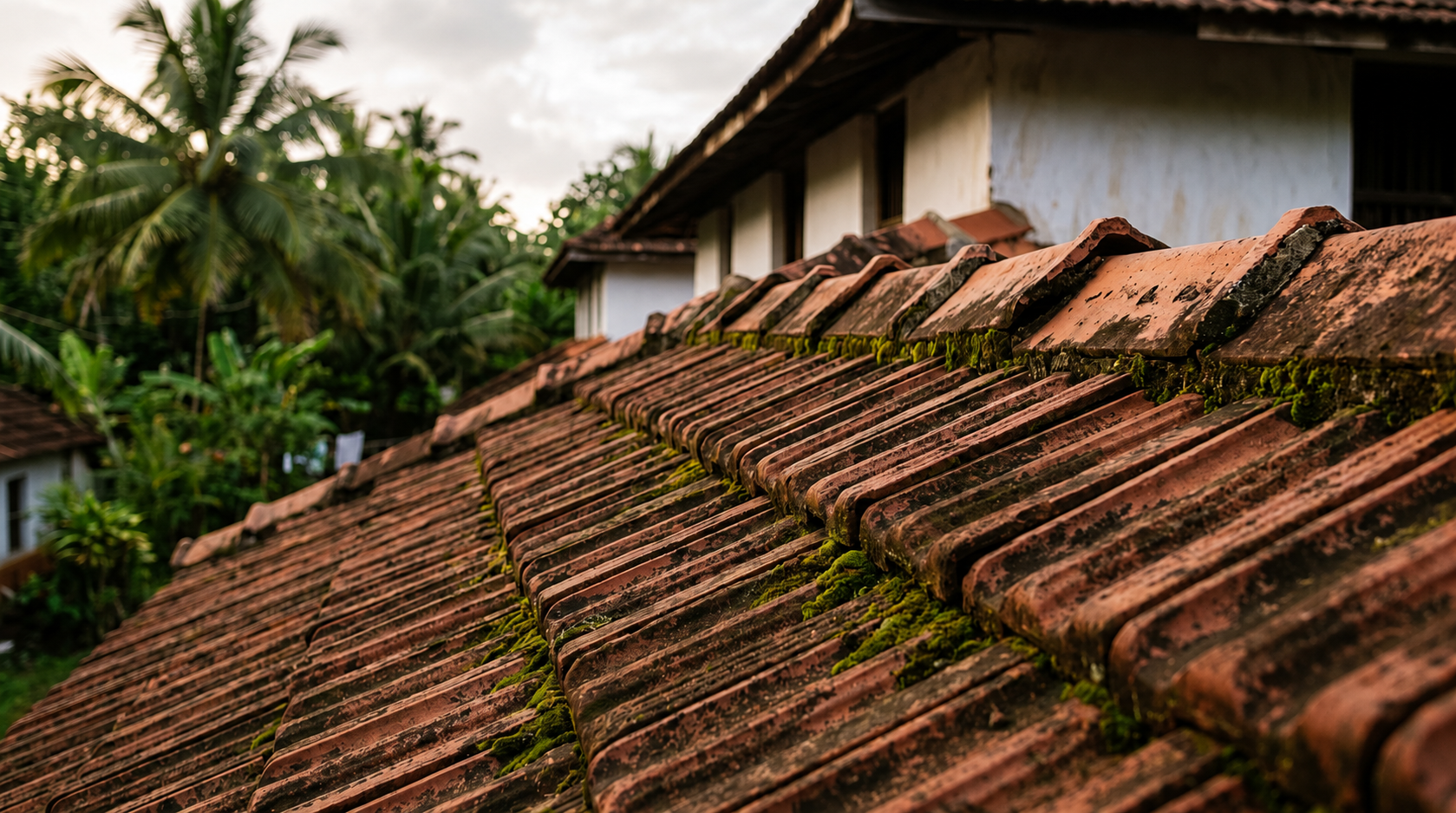
Look down on any old coastal town in this part of India — Mangalore, Kozhikode, half of Bombay's mill quarters — and the roofs run the same deep terracotta red, ridge after ridge of it, each one made of small flat tiles that hook together like scales. That colour is not an accident of local earth. It is a manufactured thing, invented on a single bend of the Netravati river a little over a century and a half ago, and for a while it roofed an empire. The tile even has a name that travelled without it: wherever it landed, from Rangoon to Zanzibar, people called it a Mangalore tile.
It began with a German. Georg Plebst, born in 1823, came to the coast in 1851 as a missionary of the Basel Mission — the Swiss-German Protestant society that had set up on the Malabar and Kanara coast in the 1830s and ran, alongside its churches, a string of workshops meant to give its converts a living. Plebst's eye fell on the clay. The Netravati and the Gurupura, the two rivers that meet the sea at Mangalore, laid down beds of a fine, plastic soil that fired to a hard, even red. In 1860, near Morgan's Gate on the Netravati's bank, he opened the first tile factory in India. Its formal name was the Commonwealth Trust; everyone on the coast called it the Basel Mission factory, and does still.
The thing Plebst made was a genuine improvement, not just a novelty. The roofs of the coast had been thatch or heavy country tile, one thing that rotted and another that cracked and let the monsoon through. The Mangalore tile was pressed in a mould to an exact shape, with interlocking grooves so the tiles gripped each other and shed water down the line without a gap, and small nibs underneath to hook over the batten. It was light, it was regular, it could be made by the thousand and stacked and shipped, and it did not leak. On a coast that takes three or four metres of rain in a season, that last fact was close to miraculous. The Basel Mission, whose whole industrial project was to turn converts into wage-earners with a trade in their hands, had found its trade.
What followed was a boom that outgrew the mission entirely. Where there had been one factory in 1860, there were around twenty-five by 1900, and by the early 1990s roughly seventy-five tile works ringed Mangalore, clustered along the rivers that fed them clay and the port that carried the tiles out. They employed thousands — men at the kilns and presses, women and children in the drying yards turning the green tiles under the sun. The tile went up the Indian coast and inland to places that had never seen the sea, and then it went abroad: to Ceylon and Burma, across the Bay of Bengal to the Far East, west to the Gulf and East Africa, and further still to Europe and Australia. Under the Raj it carried a kind of official blessing — the Mangalore tile was the roof specified for government buildings. It is the tile over the great railway termini of Bombay and the barracks and bungalows of a dozen hill stations, a small red rectangle stamped, very often, with the maker's name and a lion or an elephant.
That stamp is worth pausing on. Turn over an old Mangalore tile — and millions of people across South and Southeast Asia have, clearing a roof after a storm — and you find raised letters on the underside: the factory's name, sometimes a date, a trademark beast. It is one of the more quietly astonishing facts of Indian industrial history that a single small city branded the roofs of half a continent, and that the brand held. "Mangalore tile" became a generic, the way a place-name sometimes does when its product is good enough for long enough.
Then the century turned against it. The change was not dramatic; it was a slow substitution, and it came from below. Reinforced concrete arrived, and with it the flat slab roof — cheaper over time, faster to lay, able to carry a second storey and a water tank, and free of the endless small repairs a tile roof demands after every monsoon. A family building a new house in the 1980s increasingly chose the slab, and the sloping red roof began to read as old-fashioned, a thing the previous generation had. Demand slid. At the same time the raw material started to run out: the river clay that made the tile possible had been dug for a hundred years, and stricter limits on sand and clay extraction — meant to save the rivers — cut the factories off from the one thing they could not do without.
The arithmetic since is stark. Of the roughly seventy-five factories working in the early 1990s, only around a dozen were left by the 2010s, and by the most recent accounts a mere handful — three or so — are still firing. The rest are silent sheds, or plots sold off for the apartment blocks that now go up with concrete roofs. The old firms that survive run thin: one long-standing maker cut its workforce from a hundred and forty to seventy just to stay open, and the trade describes itself, without much melodrama, as being on life support. The clay is scarce, the young workers have gone to easier and better-paid jobs, and the buyers are mostly restorers and the nostalgic — people re-roofing a heritage bungalow, or building a new house that wants to look like an old one.
There is a particular sadness in a manufactured tradition dying, different from the loss of an old craft. The Mangalore tile was never ancient; it was invented, by a named man, in a datable year, out of a mission's very deliberate plan to make a living for its converts. It is barely older than photography. And yet in a century and a half it became so completely the look of the coast — and of much of colonial India — that its red is what people mean when they picture "an old Indian roof." To lose it is to lose something that was made, on purpose, and made well, and that then quietly became the background of millions of lives.
The coast still wears it, for now. Fly into Mangalore and the older neighbourhoods are still tiled in that unmistakable red, softened and mossed by the rains, patched here and there with a lighter new tile where a storm took the old ones. Somewhere on a river bank a kiln is still lit, still pressing the interlocking shape Plebst brought back from Europe and set down in Netravati clay in 1860. Whether it will be lit in another twenty years is an open question, and the honest answer is probably not — not at any scale. But the roofs will outlast the kilns by decades, holding off the monsoon a little longer, red against the green, long after the last factory that could replace a broken one has gone cold.