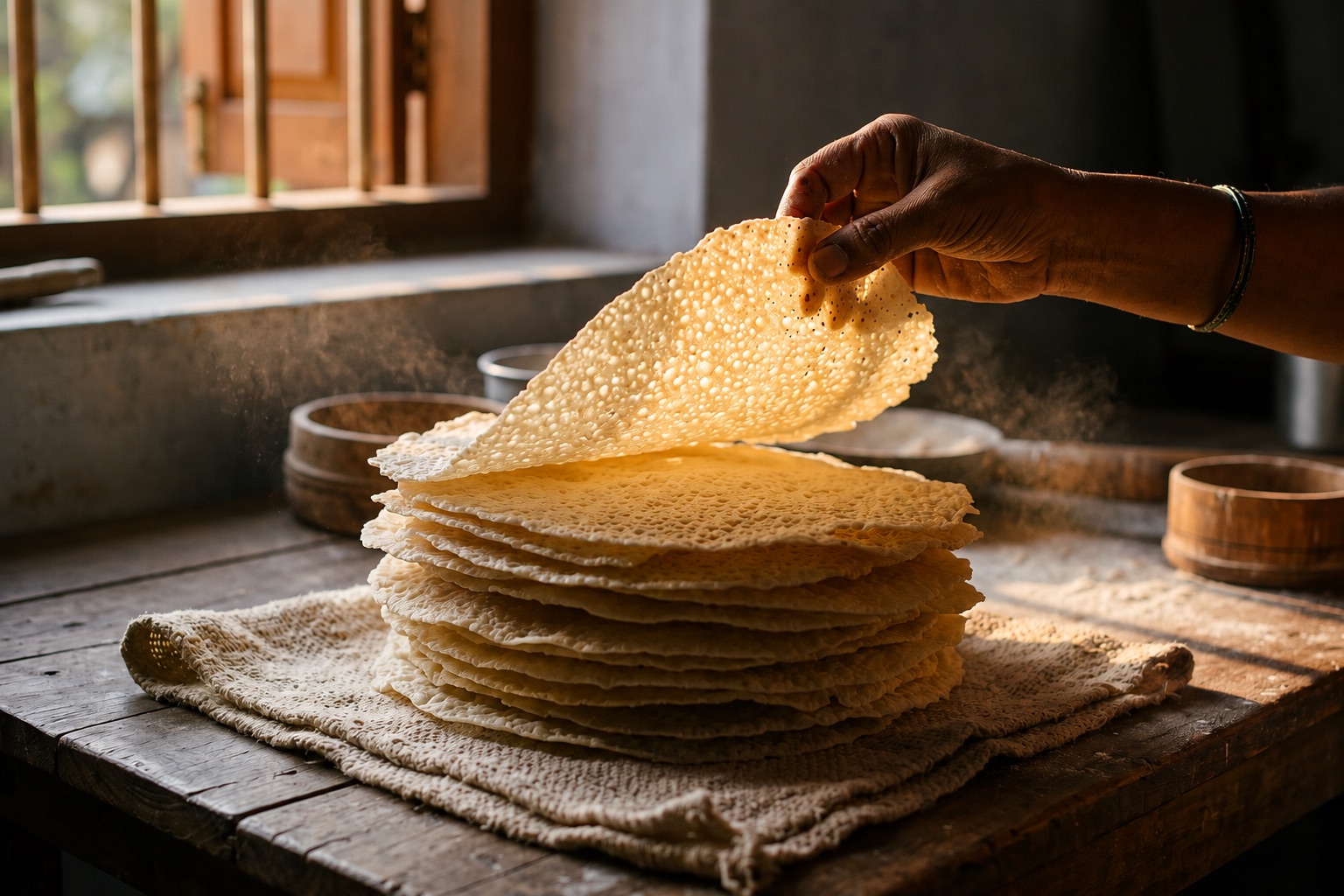
The rotti announces itself before the curry does. A sheet of roasted rice, dry as paper and near as light, breaks under the thumb with the sound of a twig going underfoot. At the table someone snaps a second sheet into a wide steel bowl, then a third, until the pieces lie in a loose heap. Then the gassi comes, a chicken curry the colour of dark brick, and it goes over the rotti from a slow ladle. For a breath the pieces hold their shape. Then they start to drink.
That first minute is the whole argument of kori rotti. The cook pours the curry late, at the table, so the wafer soaks without melting. Wait too long and it slumps into porridge. Catch it right and the spoon lifts both textures at once, a shard still crisp at the centre and an edge already soft, under a gravy heavy with ground coconut and red chilli. Tulu keeps a separate word for each half of the plate. Kori is chicken. Rotti, here, is not the soft wheat bread of the north. It is a brittle wafer of rice, baked hard and stacked in squares like sheets of pale slate. The dish is two crafts that grew up in different corners of the kitchen, brought together in a bowl.
The plate belongs to Tulunadu, the coastal strip of southwest Karnataka that runs down through Mangalore, Udupi and Kasaragod, where people speak Tulu and cook with the rice and coconut that grow to the edge of the water. It is a feast dish first. At a Bunt wedding, the Tuluva farming community whose kitchens carry much of this food, the rotti and gassi tell the guests the meal is an occasion, ladled out in quantities meant to be remembered. Long ago the dish walked out of the wedding hall. In the working hotels of Mangalore, the plain ones with wipe-clean tables and the day's catch chalked on a board, kori rotti is an ordinary weekday lunch.
The wafer is the harder half to make and the easier half to notice. It begins with boiled rice, the parboiled grain the coast has long favoured, soaked overnight and ground to a thin batter. A woman spreads a pale round on a hot griddle, lets it set, lifts it, and lays it out to dry. Done well the sheet turns glassy and brittle and keeps for weeks in a tin. Done poorly it bends and sours. For most of a century this was housework, unpaid and unlisted, slipped into the morning before the real cooking started, and the women who were good at it were known for it inside the family and nowhere else.
Now the sheets come in plastic. Bakeries and small units around Mangalore press kori rotti by the thousand, seal it in printed packets, and ship it to shops across the city and in boxes to the Gulf. A Mangalorean in Dubai can tear open a packet pressed a week ago and eat something within reach of home. The trade is plain enough: the factory wafer is thin, even and easy to find, and it tastes of no particular house.
The gassi is where a kitchen shows its hand. Grated coconut goes into a dry pan and browns over a low flame until it smells of toast. Dried red chillies follow, Byadagi for the most part, the wrinkled Karnataka chilli that gives more colour than heat, so the curry can run a deep red without scorching the mouth. Coriander seed, cumin, peppercorn, garlic, a lump of tamarind: the cook roasts them, grinds them into the coconut, and works the mixture to a wet rust-red paste. The chicken simmers in it until a slick of oil rises to the top. Every household grinds its masala a shade differently, and people can taste whose kitchen a gassi came out of the way they might know a hand from its writing.
The logic of the dish is the logic of the coast. Rice filled the flats between the Western Ghats and the sea, coconut palms stood in every yard, and the backwaters and the Arabian Sea handed up fish while the household kept its chickens. Kitchens rich and poor drew from the same short list, and a wafer of dried rice was a way to carry a little curry a long way and make a small pot feed a full table. Families with land and grain to spare turned the daily pairing into a banquet, and the banquet became a marker of who could set a good table. Fishing families and farming families, Hindu and Christian kitchens, each kept a version of the idea, and each makes a case for its own.
Kori rotti moves now the way its people move. Mangaloreans have left the coast for generations, for Mumbai and Bengaluru and the Gulf, and the dish went in the luggage, onto restaurant menus a long way from any paddy field. Cooks abroad build the gassi from memory and buy the wafer in packets. A vegetarian gassi stands in where chicken will not do, laid over the same roasted coconut and chilli. The rotti bends to the trip and holds.
The gassi is safe. A thousand kitchens cook it fresh every week, and a cook who makes it well will not want for buyers. The wafer is the part that could go. Fewer homes spread their own now, the skill rests with older women, and the packets close the gap without much fuss. Something thins out when a food that once tasted of one particular morning arrives sealed and stamped with a date. The sound, though, has not gone. In a hotel off a Mangalore street at noon, a hand still snaps a fresh sheet over a steel bowl, the crack travels across the room, and the curry goes over the top while the rotti is still listening.