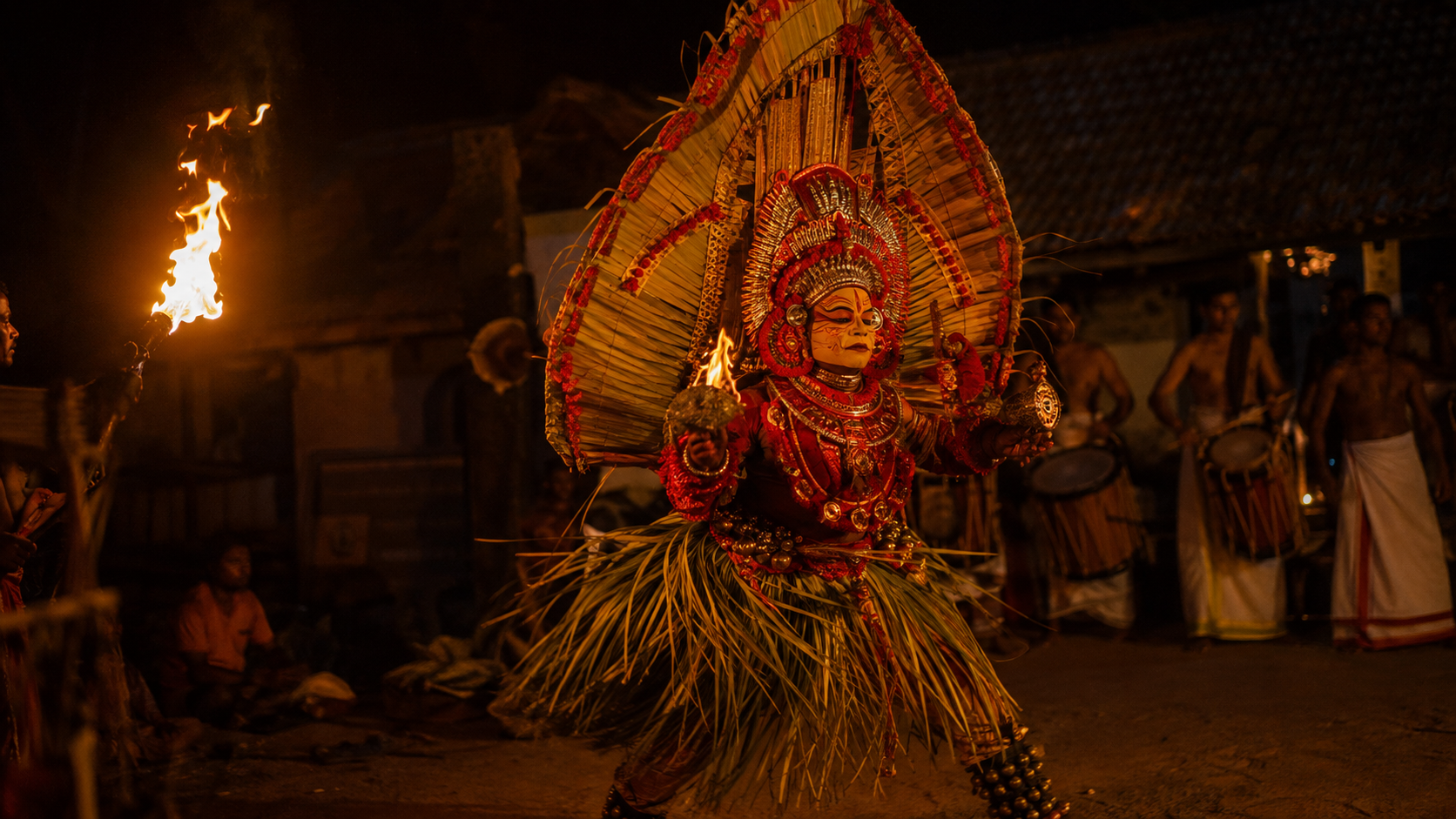
The drum finds you before your eyes do. It comes across the dark of the courtyard in a low, insistent pattern, the tembare and the taase working against each other, and the crowd on the packed earth goes quiet in pieces. Somewhere near the shrine a man is being turned into something else. Oil, then soot, then a paste the colour of raw turmeric goes onto his face in lines a helper lays down from memory, curve after curve, until the face underneath is gone. They tie bunched coconut fronds at his waist and heavy brass anklets at his feet. Last comes the ani, a tall halo of split bamboo and painted cloth strung to his back, so wide he has to turn sideways to pass a doorway. When he stands, he is no longer the size of a man.
This is a bhuta kola, the spirit-worship ritual of Tulu Nadu — the coastal strip of Dakshina Kannada, Udupi and Kasaragod where people speak Tulu and keep gods the rest of India has never heard of. The word is plain: bhuta or daiva, a spirit; kola, a play or performance. What it names is not plain at all. On a night between roughly December and May, in a village that has done this for as long as anyone can count back, a performer puts on the face of a daiva and the daiva is understood to arrive — to enter him, speak through him, and for a few hours hold court over the living.
The daivas are local and particular. There is Panjurli, whose name in Tulu means the young of a wild boar: farmers whose crops were ruined by boars learned to worship the spirit of the animal, and Panjurli became a guardian of the fields, a daiva almost every Tuluva household keeps. There is Guliga, fierce and older, said to have been born of a stone, the one you do not cross. There is Jumadi, half male and half female; Kalkuda and Kallurti, a wronged sculptor and his sister; Koti and Chennaya, twin heroes who died fighting injustice and were raised to godhood for it; Bobbarya of the sea, kept by fishing families; Koragajja, who finds what is lost. They are not distant. A daiva belongs to a place and a people, and it is expected to show up.
The man inside the paint almost always comes from one of a few communities — the Nalike, the Pambada, the Parava — and this is the part the spectacle hides. These are Scheduled Castes, communities that historically stood near the bottom of the coast's rigid order. The right to become the god, and the duty to, passes down within these families, learned by a boy who grows up watching his father and uncles at the shrine. For one night the arrangement inverts with a completeness that is hard to overstate. The landlord and the priest, men who on any ordinary day would not share his cup, stand with folded hands before a performer from a caste they otherwise keep beneath them, and wait to be judged. Before the transformation he fasts and keeps clean; the discipline is real. Then the drums climb, he takes a mouthful of toddy, the fire is lit, and something takes over the body that a moment ago was his.
What the daiva does, once arrived, is govern. The dance is only the announcement. The heart of the kola is the nudi, the oracle — the spirit speaks, in old Tulu, and the village brings its quarrels to be settled: a disputed boundary, a debt gone bad, a theft, a family split down the middle over land. The daiva hears them and rules, and the ruling holds, because everyone in the courtyard has agreed for centuries that it will. Long before there was a court or a police station on this coast, this was the coast's court. It still runs alongside the state's one, and people still bring the cases they would rather a god decided.
None of this floats free of the ground it stands on. The bhuta belongs to the guttu, the old landlord manor, and the manor belongs to a family — very often of the Bunt farming caste, the coast's traditional landholders. The great house sponsors the annual kola, feeds the village, and keeps the shrine; in return the daiva blesses the harvest and keeps the peace, and the produce of the land is redistributed at the ritual. It is a beautiful machine and an unequal one. The god who steps down among the poorest for a night is maintained by the richest, and when the night ends the arrangement snaps back into place. The performer who was worshipped washes off the turmeric and, by morning, is a man from a Scheduled Caste again, often with a wage that does not match the awe.
The old songs carry the memory. The paddanas — long oral epics in a Tulu older than the one spoken now, sung by women as they transplant rice and by ritualists at the shrine — tell where each daiva came from: the murder, the injustice, the drowning, the promise, that turned a person or an animal into a god. They have no single author and no fixed text. They are how a community without a written scripture kept its theology, in verse, in the fields, for a very long time — some of it from a layer that likely predates the Sanskrit gods on this coast entirely.
Then, in 2022, the coast's private god walked into a multiplex. Kantara, a Kannada film built around a Panjurli-Guliga kola and a performer possessed, became one of the biggest hits the region has produced, and suddenly a ritual that most of India had never seen was a national phenomenon. The final sequence, a real-feeling trance in a torchlit clearing, sent people who had never heard the word bhuta looking for the nearest kola. For the communities who actually carry the tradition, the attention was double-edged. Recognition arrived; a market arrived with it. The Government of Karnataka moved to grant a monthly allowance to performers over sixty — an admission, in the language of the state, that the men who become gods had been left to grow old poor.
That is the tension the paint cannot cover. The demand for kolas is, if anything, rising — there is fame in it now, film crews and phone cameras and outsiders who want the spectacle without the obligation that used to come attached. The precarity of the people who perform it has not moved much in step. The knowledge still passes father to son, but the sons now weigh it against a job in the Gulf or a diploma in Bengaluru, and not all of them will choose the ani. Meanwhile the disputes over who owns which shrine, who has the hereditary right to a particular daiva, and who takes the money the fame brings in have started, with a bitter aptness, to end up in the state's courts — the very institution the daiva's own court predates.
Still, on the right night, in a courtyard that has no film crew in it, none of that reaches the packed earth. The drum climbs, the fire goes up, the halo turns in the dark, and a man from a family the village keeps at arm's length becomes, for a few hours, the one being in the coast that everyone present is afraid of and grateful to at once. He speaks; they listen; the wrong is named and set right. Then dawn comes off the sea, the paint comes off his face, and the god goes back to wherever gods wait — leaving behind a man, and a debt the daylight has never quite settled.